
Why this matters → (30 sec read)
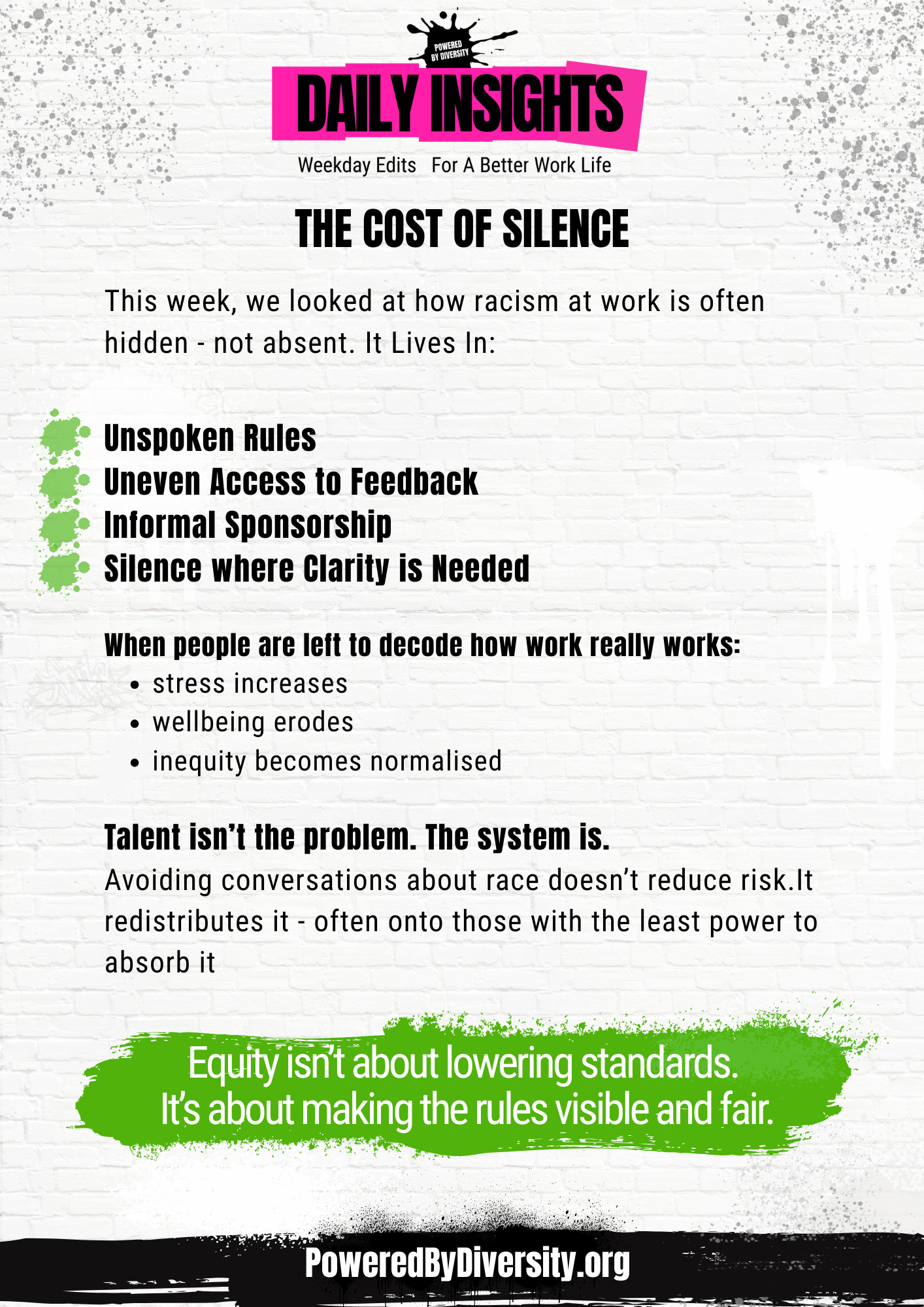
This week, we explored how racism at work often operates quietly, through what isn’t said, rather than what is.
We looked at unspoken rules and hidden expectations, the stress of constant self-monitoring, the unequal access to feedback and sponsorship and how silence disproportionately affects wellbeing.
What became clear was this: When clarity is uneven, stress isn’t shared equally.
Avoiding conversations may feel easier in the moment.
But for those left guessing, the cost accumulates - mentally, emotionally, and professionally.
For leaders → (30-second read)
This week reinforced a critical truth: Racial inequity at work is sustained by systems that rely on informality, silence, and assumed knowledge.
When leaders avoid conversations about race, they don’t remove risk, they redistribute it — often onto those with the least power to absorb it.
Clarity isn’t about confrontation - it’s about fairness.
And fairness is foundational to wellbeing, trust, and performance.
Bringing it all together
Across Race Equality Week, one pattern consistently emerged.
Stress doesn’t just come from workload or pace, it also comes from navigating environments where the rules are unclear — and unevenly applied. Unspoken expectations force some people to carry more and over time, that load becomes unsustainable.
Racism at work often hides in these dynamics — not always in what is explicitly said or done, but in what is allowed to continue unquestioned. This is what people mean when they talk about ‘unfair systems’.
Equity (fairness) work that avoids clarity will always fall short, because wellbeing can never really thrive in systems that are not allowed to be discussed.
Reflection
Where might silence be doing more work than policy?
What would change if clarity were treated as a shared responsibility, not a personal burden?
🔔 coming up on The Work Edit:
Next week, we’ll shift to practice. What can we actually do to change things?
Want to feel more confident talking about Race and other topics at work?
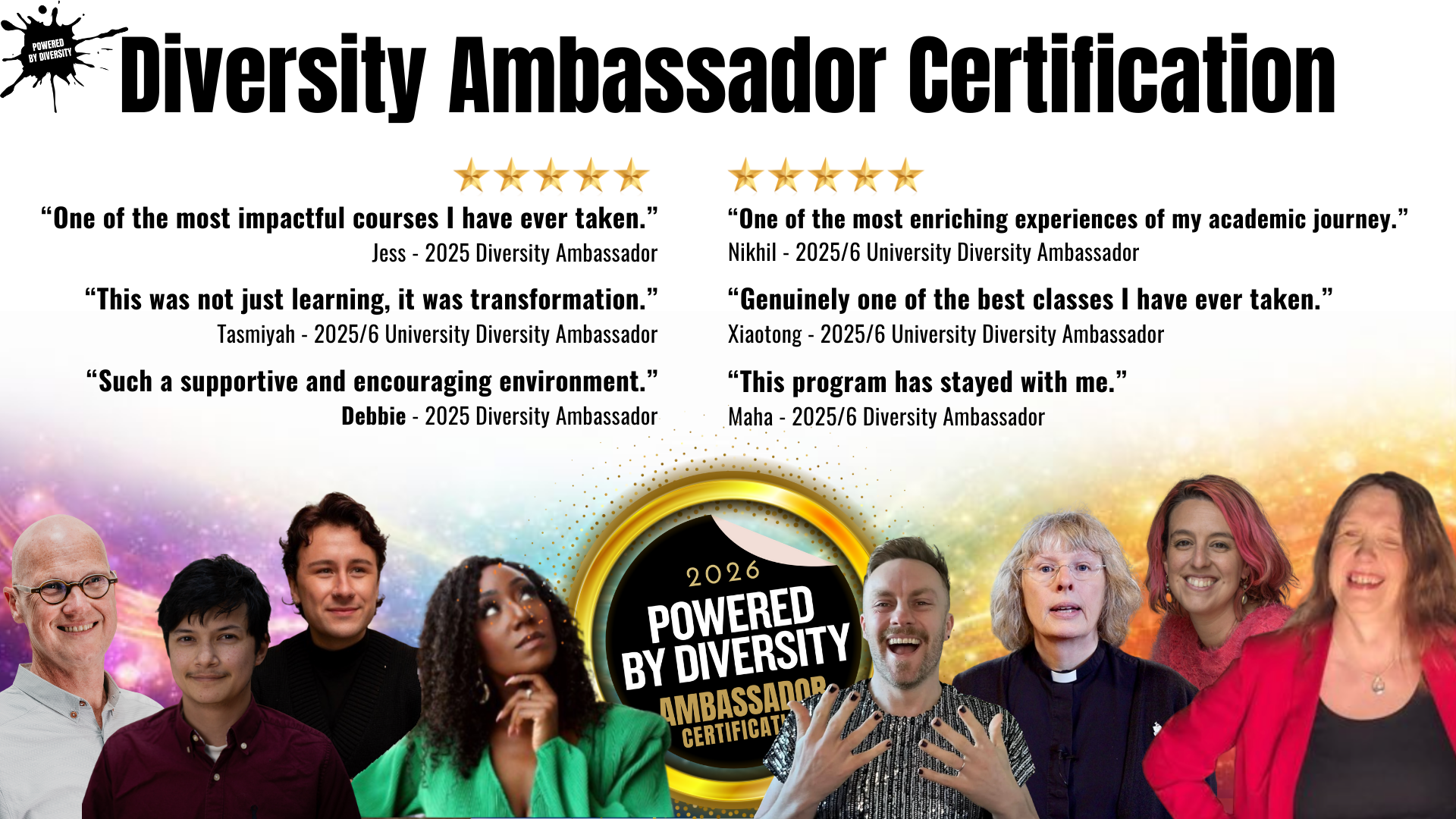
the 2026 Diversity Ambassador certification is now open for booking! 🎉
Six classes held via Teams | Every Thursday | from 12 - 1:30pm | From May 7th - June 11th
When are the Classes?
Thursday 7 May, 12-1:30 - Examining Beliefs - Foundations of EDI Thursday 14 May, 12-1:30 - Today's Sex & Equality Landscape
Thursday 21 May, 12-1:30 - Flags, Pronouns & Human Rights Thursday 28 May, 12-1:30 - Talkin' 'Bout my Generation
Thursday 4 Jun, 12-1:30 - Anti-ableist. Neuro inclusive. Access for all Thursday 11 Jun, 12-1:30 - Talking About Race Today
Click here to book your place! (please be aware the cohorts fill up quickly)
You can find out more here or Get in touch for a chat
coming up on Cultural Calendar Club
12 Months of live, inspiring, entertaining talks events, made financially accessible for all organisations
Not yet a member of Cultural Calendar Club? Join today or Contact Us.
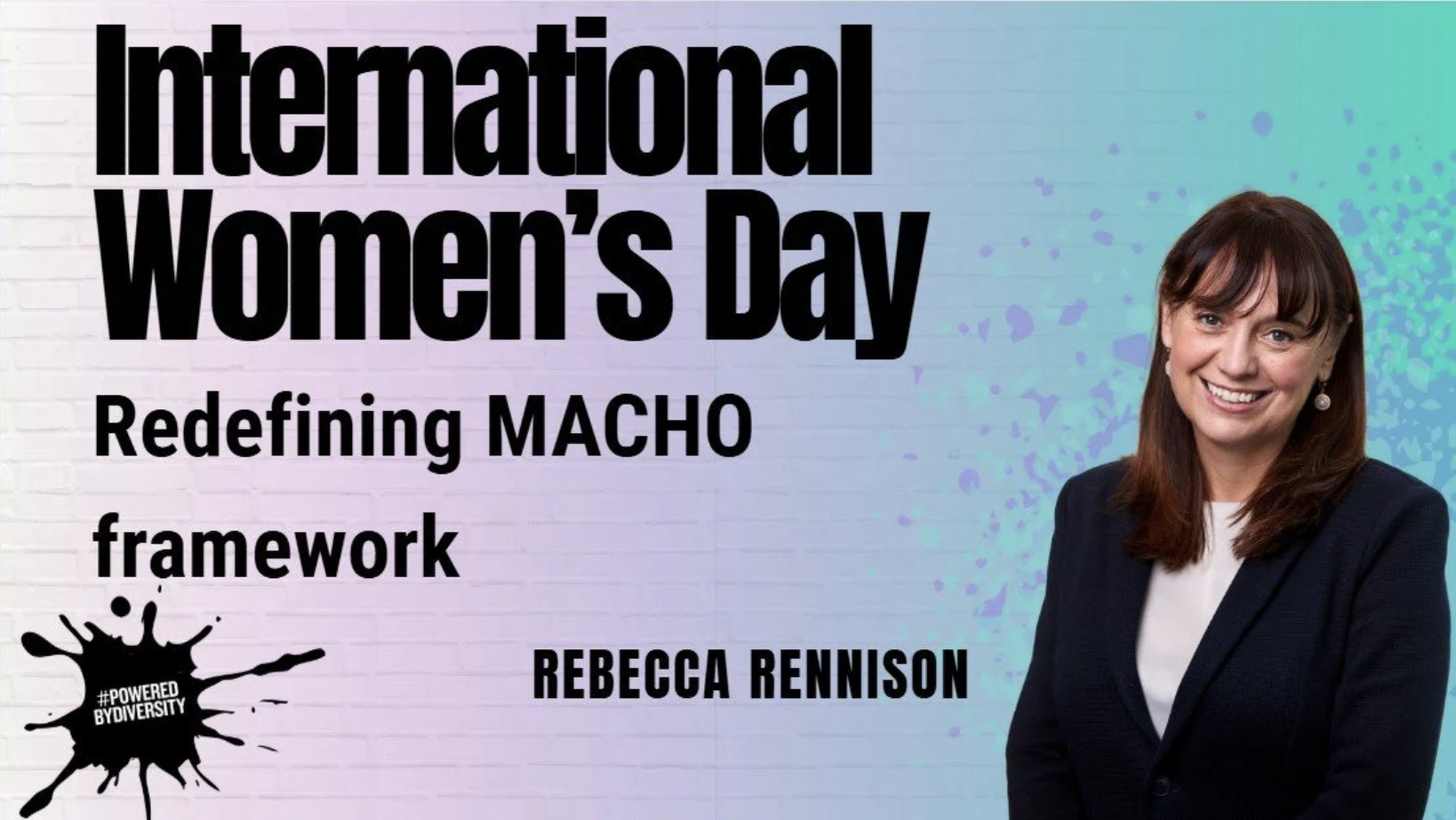
International women’s day
Redefining macho
Monday 9 March 2026
12:00 13:00
Not yet a member of Cultural Calendar Club? Join today or Contact Us.
Rebecca created the “Redefining MACHO” framework to encourage better male allyship and foster a more diverse and inclusive workplace. This framework consists of five simple, actionable steps that everyone can implement today to enhance DE&I within their organisations and the broader business community.
M = Meaningful Mentor
A = Amplify Awareness
C = Capture Confidence
H = Harmony with Home
O = Orchestrate Opportunities
Rebecca will discuss how this framework can unlock numerous small actions that collectively support the development of diverse teams, actively champion equity, and ensure that inclusion is experienced by all. She has conducted several “Redefining MACHO” workshops and events, gathering valuable feedback and real-life examples that provide a clear roadmap for change.
She will also share her “Work Life Harmony Handbook” and “Confidence Boosting Alphabet” to help SMASH Imposter Syndrome.