LGBTQ+ Inclusion at work
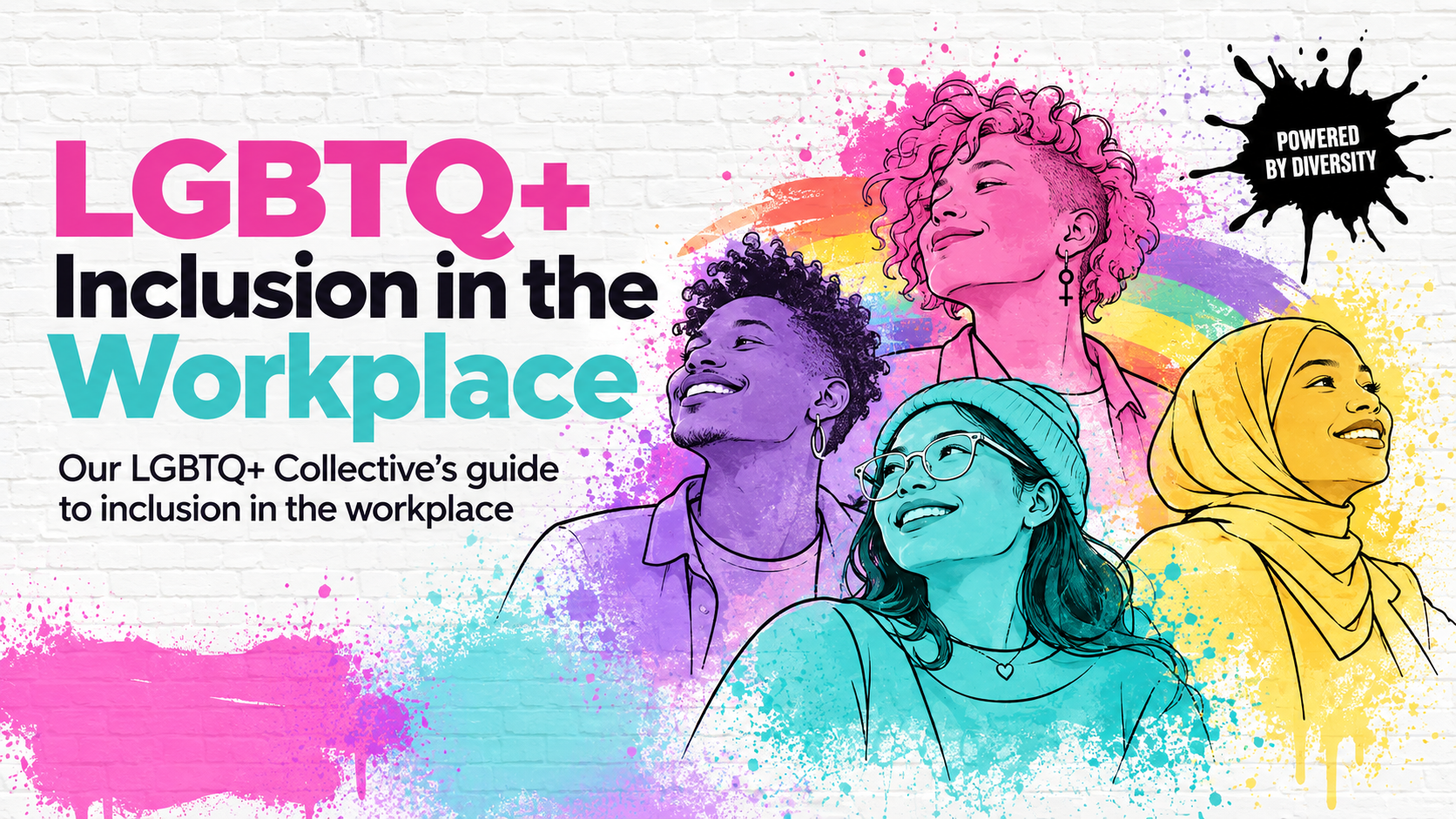
Welcome to our LGBTQ+ Collective’s guide to inclusion in the workplace
What is LGBTQ+?
LGBTQ stands for Lesbian, Gay, Bisexual, Trans, Queer or Questioning.
The “+” stands in for all the other descriptors for orientation - there are over 40, including Pansexual, Demisexual, Graysexual - the initials and the various terms and descriptors are evolving fast!
Being inclusive is absolutely not about memorising the whole list - it’s all about being open-minded, respectful and using the terms that people offer and prefer.
If you are unsure about a term - or a pronoun - our advice would always be to respectfully (and privately) ask.
Gender and Sex
There is a huge crossover between how we talk about gender and sexual orientation today.
The easiest way of navigating gender, sex and sexuality is for everything to take place at an individual level.
You should definitely attempt to educate yourself as much as possible - but if your aim is to always work at an individual level, there is no need to become an expert on all topics of gender, sexuality and sex.
For example:
Sam describes themselves as gender non conforming, and prefers the pronouns 'they/them'. I don’t know if Sam was assigned male or female at birth - but I do know they like halloumi salad, Star Wars and indie music.
If you know Sam, and you want them to feel accepted, valued and included, you would make an effort to get to know them on an individual level - that would include finding out which pronouns they use, and you might also read up about gender nonconformity (and Star Wars).
You wouldn’t, as a result of knowing Sam (and understanding Sam’s interpretation of gender nonconformity), also know Charlie.
You would need to get to know Charlie on an individual level to discover their personality as well as their preferred pronouns (and you might also discover how they prefer to describe their gender).
A rule of thumb is that regardless of how people present externally (i.e. what they look like), a person’s identity, behaviour and preferences should never be assumed, based on their sex (biological or assumed). This rule of thumb holds true for all people of all races, religions, cultures, ages, preferences and genders.
Check out An Introduction to Sex, Gender & Equality for more on sex, gender and what the difference is.
Gender Identity and Expression
Traditionally, society has viewed gender as binary: male or female, with particular expectations about how each should look, behave and live.
Today, gender is increasingly understood as a spectrum rather than two fixed categories.
A person's gender identity is their own internal sense of who they are, which may or may not align with the sex they were assigned at birth.
Gender identity is about how a person understands and identifies themselves, while gender expression is how they choose to present themselves to the world, for example through their clothing, appearance, behaviour or mannerisms.
Importantly, a person's gender identity and expression do not have to conform to traditional expectations of “masculinity” or “femininity”.
People of all genders, whether they identify as LGBTQ+ or not, may reject the idea that their sex should determine how they look, behave, dress or live their lives.
ACTIVITY
There are now over 50 terms (some can list over 70) that people can use to describe their gender including gender fluid, non-binary, gender queer.
Instead of aiming to memorise all the terms or understand them all, focus your education on the bigger picture and aim to reach a place of personal understanding, acceptance and/ or tolerance:
Understand why some individuals want to break away from describing themselves as a binary gender.
Develop a stance in support of individuals who want to express themselves differently to the way you do.
Find words to articulate your advocacy and support of people who are breaking away from “gender norms”.
Cis and Trans
Some people identify with the sex they were assigned at birth - and some don’t.
Many transgender inclusion activists advocate the use of “cis-gender” to describe people whose genders match with their assigned sex.
So they might use the term “cis-woman” to refer to someone who was assigned as a female at birth, who identifies as female. They might use the term “cis-man” to describe someone assigned as a male at birth, who identifies as a man.
A transgender person is one whose gender identity is different to that assumed of them due to their sex assigned at birth.
A transgender woman or Trans-woman is a person who was assigned male at birth but identifies as female. Internally they “feel” female and are female.
A transgender man or Trans-man is a person who was assigned female at birth but identify as male. Internally they “feel” male and are male.
Some transgender women argue that although they may not be medically or biologically female, they are female and deserve the same rights and opportunities as people who were assigned female at birth.
Some transgender men argue that although they may not be medically or biologically male, they are male and deserve the same rights and opportunities as people who were assigned male at birth.
Some people argue that people who were assigned male at birth should not be allowed the same rights as people assigned female, for example access to female-only spaces like changing rooms and toilets.
Regardless of your opinion on this point, it is very important to understand that to transgender people, they “are male” or “are female” even if their bodies, medically “are not” or “are not yet”.
Purposely misgendering somebody or denying them access to the group to which they feel they belong can be extremely hurtful and is often termed "transphobia".
Transgender
In the past, transsexual, “transvestite”, and “gender identity disorder” were the terms used to medically and psychologically categorise people who had a gender (or external appearance) that differed from their sex assigned at birth.
Because these terms were used during a period where being Trans (gender or sexual) was “medicalised” and treated as a disorder, the words transsexual and transvestite are now largely rejected by the trans community.
Some transgender people decide to undergo operations, treatments or procedures in order to align their external appearance more closely with their internal gender identity.
Treatments vary greatly from hormonal treatments to gender reassignment surgery.
Not all transgender people undergo any or all treatments.
Some people (including some transgender people) do use transsexual to mean a transgender person who has undergone an operation, treatment or procedure in order to more closely align their physical bodies with their internal gender identity.
It is important to note two things here: firstly that not all transgender people undergo all (or any) treatments and secondly that you should always use the terms that an individual uses to describe themselves. If in doubt, always ask, rather than assuming.
Some people use the term transsexual to describe the fact that they have “fully transitioned”, meaning they are now recognised as male or female, physically and officially (for example on their passport and driving license) though the term transsexual is becoming less and less commonly used.
Terms to avoid which are offensive: “tranny”, “transvestite”, “transsexual”. (unless they have specifically stated transsexual as a preferred term).
Pronouns and Names
Some gender non-binary and many transgender individuals choose to adopt a different name and ask to be referred to by the pronouns (e.g. she, he, they) which match their gender identity.
Inclusion-wise it is imperative that you respect the chosen name and pronouns of all individuals, just as you do cis-gender individuals.
If Andrew doesn’t like to be referred to as Andy, you would try to remember not to call him Andy, (unless you were purposely trying to annoy him).
Likewise, if Andrew refers to himself as “he” it is unlikely that you would ever refer to him as “she” or “they”.
This is just the same principle for transgender and non-binary individuals who have their own pronoun and name preferences.
“My adult son is transgender and although it’s been almost a year, I still forget sometimes, not so much with his name but with his gender. I sometimes slip up and say “she” or “her”. I feel terrible when I do and I apologise, but he understands this and is very accepting - because he knows I am trying”
Ellen, mum of Izack
If you have known somebody before they transitioned and after, it can feel difficult at first to break those old name and gender associations.
If you make a mistake and accidentally use the incorrect gender (usually referred to as misgendering) or use somebody’s old name (usually referred to as deadnaming), simply apologise and remember next time.
The crucial thing with this is that you acknowledge the mistake (don’t just pretend it didn’t happen), apologise, and keep trying.
The Law and Employee Rights
Time off for gender reassignment is, by law, to be treated the same as time off for sickness or injury.
By law an employer must treat an employee undergoing gender reassignment (any kind of treatment, not just surgery) the same as they would for an employee who is absent due to sickness or injury.
In the case of other absences to do with gender reassignment, for example counselling, by law an employer mustn't treat an employee less favourably than they would if they were to take time off for reasons outside of sickness.
An employer must be able to show they acted reasonably to prove that it was not unlawful discrimination.
It’s important that, as a business, you have a stance on how you will treat transgender employees and to agree this up front and communicate it internally and to prospective employees and customers.
Will you treat transgender employees as their communicated or expressed gender identity?
How will you do this?
Will they have equal rights to all spaces, opportunities and treatment as their cis-gender colleagues?
How will you involve the wider organisation in your decision making process?
How will you ensure transgender employees are included and accepted at work?
How will you communicate with employees who do not accept your stance?
Sexuality and Stereotypes
Stereotypes are extremely damaging - regardless of the stereotype or the group they are describing.
A stereotype is a widely held but fixed and oversimplified image or idea of a particular type of person. It is rare that an individual will conform fully to a stereotype, and the damaging thing about stereotypes is that if an individual conforms to one area of a stereotype, very often the full weight of all of the assumptions associated with that stereotype is piled onto them as well.
ACTIVITY
PART 1
Think about some stereotypes about the sex, orientation or gender you identify with.
What areas of the stereotype do you conform to - and which areas are nothing like you?
How does it make you feel knowing that this stereotype is used so widely to describe your sex/ gender/ orientation?
What do you wish people knew about you - outside of the stereotype?
What would you say to a person who made assumptions about you based on this stereotype?
PART 2
Think about some stereotypes often associated with Lesbian, Gay, Bisexual, Queer or Trans people. Imagine that you identify as a belonging to one of those groups but you are nothing like the stereotype says:
How does it make you feel knowing that this stereotype is used so widely to describe your group?
What do you wish people knew about you - outside of the stereotype?
What would you say to a person who made assumptions about you based on this stereotype?
Let’s (not) talk about sex
There is one particular point of privilege that cis, heterosexual people in particular benefit from, which is that generally, they aren’t burdened by knowing that people are thinking about their sex lives.
Shaun Dellenty Powered By Diversity Collective Member explains this perfectly in one of his talks, in which he shows a pie chart of how he spends his life: walking his dog, meeting friends, eating meals, sleeping, working, exercising, travelling, domestic duties, relaxing, writing. At the end there is a little slice of pie which he calls “jiggy jiggy”.
Shaun makes the point that, upon finding out that he’s married to a man, many people’s minds immediately snap to what he gets up to in that relatively tiny sliver of time - but why? Just like hereosexuals, there is so much more to his life than just the “jiggy jiggy” part.
Extending this point of heterosexual privilege out - nobody knows for sure what heterosexual people get up to in their sex lives.
When you think about it, it could be anything...their preferences could be much more “exotic” than what your LGBTQ+ neighbour is getting up to in theirs.
However as heterosexual people, it's likely that you’re not particularly concerned that your sex-life is being given much thought. Unfortunately for many LGBTQ+ people, this is a very real burden for them to carry.
A rule of thumb for life is generally not to obsess about what someone gets up to in the bedroom, and certainly not inquire about it in polite conversation, especially not in the workplace. This goes for all people, all orientations, male/female, cis/trans and across all races and religions.
Trans and Sexuality
Being transgender is more about a person’s identity than their sexual orientation.
A transgender person is an individual just like everyone else, and, just like everyone else, trans people have their own sexuality.
A trans person can be Straight, Lesbian, Gay, Bisexual, Queer, Questioning or any of the other orientations/ sexualities there are.
So with all this in mind, what is lgbtq+ Inclusion?
What Inclusion is
Inclusion is knowing someone has thought about your needs, considered your feelings before acting, asked for your point of view before deciding, and viewed your input as valuable. It’s about being remembered, invited, asked for your opinion, consulted, considered and not left out.
Feeling included is not feeling like you need to hide your sexuality or your relationship, gender, religion or any other part of your identity. It’s not feeling the need to change the way you speak, dress or do your hair to “fit in”. It’s feeling invited be your true self at work and not only being accepted for it - but celebrated and valued for it!
Inclusion is being able to talk about what’s important to you whether that’s your partner, your family, friends, values, beliefs, hobbies or interests. It’s being valued and recognised for your contribution, regardless of your differences.
What Inclusion is not
Inclusion should not be confused with curiosity or nosiness, to be truly inclusive, you should try to keep a lid on your curiosity (and definitely on nosiness).
Revisiting the examples of Sam and Charlie from earlier.
Sam describes themselves as gender non conforming, and prefers the pronouns they/ them. I don’t know if Sam is biologically male or female but I know they like halloumi salad, Star Wars and indie music.
If you know Sam, and you want them to feel accepted, valued and included, you might invite them for a coffee in their first week - and to prep you might read up about gender nonconformity (and Star Wars) so that you are educated on what terms to use and so that you have some topics handy to talk about.
You wouldn’t invite Sam to lunch in order to find out whether they are “biologically male or female”, what it was like coming out, what their family think of their identity and whether they have had or are going to have any medical procedures.
These sorts of topics are extremely personal and should be considered completely off limits if your aim is to be inclusive.
Over time, as they become more comfortable and relaxed, Sam may offer up some of this information voluntarily - but they may not. It’s nobody’s right to know about Sam’s personal life, just as it’s nobody’s right to know about a gender conforming individual’s personal life.
An important thing to remember here is that, no matter how much you learn about Sam, you wouldn’t, as a result of knowing Sam, and understanding their gender nonconformity, also know Charlie. You would need to get to know Charlie on an individual level.
Remember that regardless of how people present externally (i.e. what they look like), a person’s orientation, identity, behaviour and preferences should never be assumed.
Not Being The Spokesperson
Inclusion does not mean asking a person or people with a certain characteristic to speak for everyone in that group. If they identify as part of the community, they might feel passionate about the topic of LGBTQ+ Inclusion - but that doesn’t mean it is their job to create an inclusive environment.
Asking a group what would make them feel included is great, better still, ask the whole workforce so that a certain group doesn’t feel singled out and under pressure to “solve” exclusion and discrimination.
An individual can only really speak for themselves and asking them to represent their whole group could be seen as unfair, or worse, dodging responsibility.
Own the responsibility for creating an inclusive workplace at leadership level and leave your employees free to contribute if they want, but also leave them free to be included in the rest of the workforce if that’s what they choose.
Asking a group to be the mouthpiece for their entire 'people' could actually lead to them feeling singled out, “othered” and less included.
Allyship
Allyship is active, not passive. It’s not enough to say “I support you” - being a true ally is acting on that statement.
Understanding LGBTQ+ History
Understanding the historic struggles of the LGBTQ+ community is key for all allies. Life has been dangerous, painful and, at many times, fatal for this community.
The struggles they have faced - and are still facing - for acceptance and inclusion and against discrimination and violence are very real and they are far from over. Understanding them is crucial for any ally.
Look out for Bullying and Microaggressions
As an organisation, you should be completely clear on where the line is and what constitutes harassment, bullying, discrimination and exclusion in your organisation.
Get completely clear, as a team, on what the consequences are for those that do cross the line, and act on it.
An organisation should never be seen to tolerate homophobic or transphobic abuse, bullying, harassment, discrimination or exclusion.
As an ally you should be on the lookout for language transgressions and microaggressions. Nip exclusionary ‘jokes’ in the bud, correct mistakes, and always be on the lookout for ways to educate others on what you have learned. As an organisation there are some changes you can make now to be more inclusive:
Always refer to “All genders” rather than “both genders”.
Be clear in your communication that you are referring to “all people”.
Be clear on how you will include transgender and non-binary employees and what your policies are.
In forms and questionnaires, add options for “non binary” or "prefer not to say".
Look out for Exclusionary Terms and Language
Look out for ‘heteronormative’ (heterosexuality as the default assumption) and narratives in your advertising, marketing, training and internal and external communications.
Examples like always featuring opposite sex couples in photographs or copy, assuming that the male will have a female partner and vice versa.
"I was at a talk at work and the person speaking was giving an example of a man. He said “his wife…” and then he became very flustered and added “...or husband...or boyfriend or...”. It was just bad.
It just showed that he was in that position where he knew he needed to do something different - but he hadn’t educated himself enough to know how to".
Rob, Training Manager
It might take a while but adding inclusion as an afterthought can look sloppy - or like you don’t care. Check with a diverse group, that your talk/ text or training is inclusive before you release it or deliver it to avoid making mistakes.
Avoid referring to ‘husbands and wives’ and opt for ‘partners’, ‘loves ones’ or ‘family’.
Avoid referring to ‘men and women’ or ‘ladies and gents’ - opt instead for inclusive terms like everyone, team, friends or colleagues.
If you are giving examples where people are in relationships, include some LGBTQ+ relationships
Why Allies Are Needed
I was at the launch of our LGBT Group at work. I had gone as an ally - but I quickly realised that I had a long way to go before I could call myself one.
I said to two of the guys on my table, that it was great that LGBT people are so free these days, compared to the struggles of the past.
They looked at each other and raised their eyebrows and one told me that he’d been attacked on public transport for kissing his partner on the cheek as he left at his stop - and the other told me he couldn’t ever hold hands with his boyfriend outside of home for fear of the same thing happening to them.
I just hadn’t realised things were still so bad.
Jess, PR Manager
More than ever LGBTQ+ allies are needed, hate crimes are on the rise and many people in the LGBTQ+ community feel far from safe living ‘out’ as their true selves.
The rate of LGBT hate crime per capita rose by 144% between 2013-14 and 2017-18. In the most recent year of data, police recorded 11,600 crimes, more than doubling from 4,600 during this period.
Transphobic attacks have soared in recent years, trebling from 550 reports to 1,650 over the period examined.
Almost half (46%) of these crimes in 2017-2018 were violent offences, ranging from common assault to grievous bodily harm.
Do Your Bit for the Next Generation
Many people think that the next generation will ‘sort LGBTQ+ inclusion out’.
Whilst it may appear many of them shrug off gender norms more readily, there are still a large number of parents against LGBTQ+ education in schools.
Those parents are also bringing up the next generation and it is crucial that we are LGBTQ+ allies not just at work, but at our children’s schools, and at home.
It’s important that you apply your allyship outside of work as much as within.
Training
Powered By Diversity offers training, talks and workshops on all areas of Diversity, Equality and Inclusion. If you'd like to arrange organisation-wide, leadership or management training on LGBTQ+ Inclusion, please contact us today.
Get in touch
Got questions - or just fancy an EDI chat?
Just fill in the form below or email us via cat@poweredbydiversity.org